A lecture preserved in fragments, then reconstructed as an argument.
The proof lived in the relation between Feynman’s voice and an evolving blackboard. A recording, sparse notes, and one lecture photograph survived; the complete blackboard sequence did not.
1846–47 / HAMILTON
Velocity space already had a history.
William Rowan Hamilton communicated his new “hodograph” method to the Royal Irish Academy in December 1846 and published it in 1847. For motion governed by Newtonian inverse-square attraction, the velocity vector’s tip runs around a circle even when the body’s path in position space is an ellipse, parabola, or hyperbola.
Feynman did not invent that circle. His distinctive move was pedagogical: use elementary geometry to make the circle in velocity space do the explanatory work, then recover the conic orbit in position space without importing the advanced conic-section machinery that had blocked his reading of Newton.
The lectures were produced through several synchronized traces.
Feynman’s two-year introductory course was not preserved by prose alone. Caltech’s surviving record combines quarter-inch reel-to-reel audio, working notes, transcripts, and thousands of lecture photographs. The recording archive now holds 122 lecture tapes; the photo archive describes 3,043 frames and credits lecture-hall manager Tom Harvey with photographing the boards, recording the talks, and preparing demonstrations.
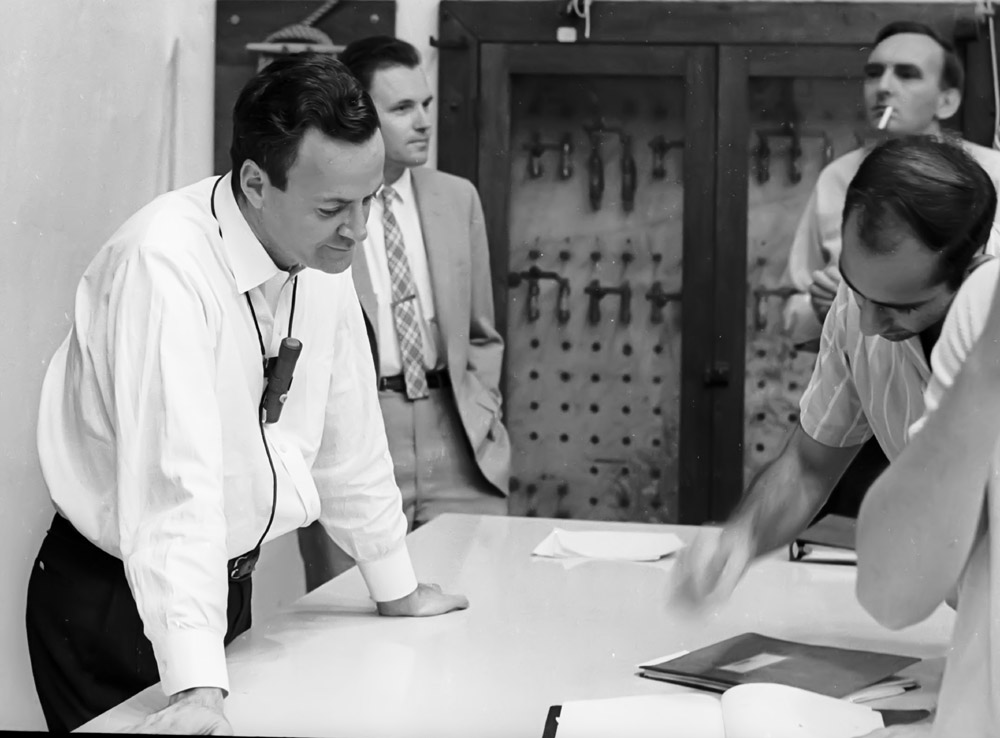
The microphone in this photograph made Feynman’s voice the privileged audio channel—Caltech notes that student questions can be difficult to hear because he wore it. That fact explains the texture of the recordings, not the loss of S55: the planetary-motion tape survived.
RECORDING PHOTOGRAPH · CALTECH · S46 · APRIL 29, 1963
Feynman wearing the lecture microphone.
Caltech identifies this scene as the recording of S46, The Dependence of Amplitudes on Time, on April 29, 1963. It belongs to the regular course, not the later planetary-motion lecture, but it makes the course’s recording apparatus physically legible.
1964 / S55
One special lecture for freshmen.
On March 13, 1964, Feynman returned to the Caltech freshman class for S55, The Motion of Planets Around the Sun. He had tried to follow Newton’s geometric proof but could not get past its specialized conic-section machinery, so he built an elementary geometric proof of his own.
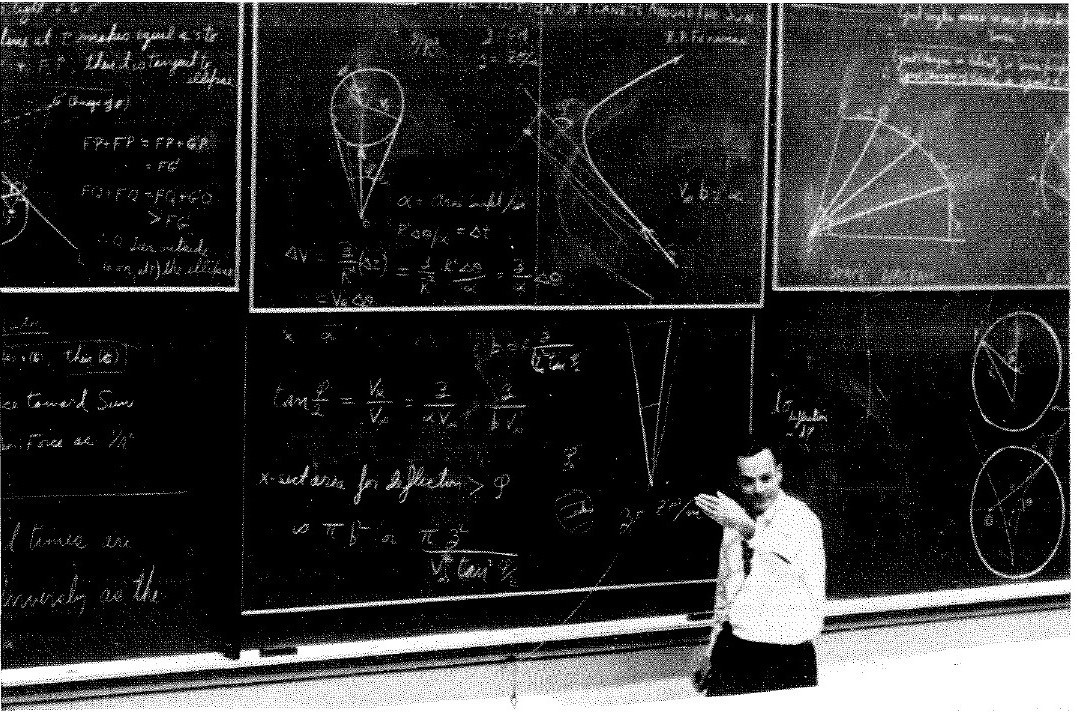
The official course index still places S55 between the 1963 second-year sequence and the lectures that resumed in May 1964. Unlike its neighbors, S55 has no full lecture-photo set. Caltech’s archive catalogs a single negative as image 1.10-5—the one surviving view reproduced below.
CALTECH ARCHIVES · IMAGE 1.10-5 · MARCH 13, 1964 · REPRODUCED BY GOODSTEIN & GOODSTEIN
The one surviving lecture photograph.
The Caltech record identifies this as Feynman lecturing on planetary motion and describes one photographic negative. The focused detail here removes only the Goodstein article’s adjacent text column; the full evolving blackboard sequence remains absent.
1964 / NOTES
A few pages hold the geometry in place.
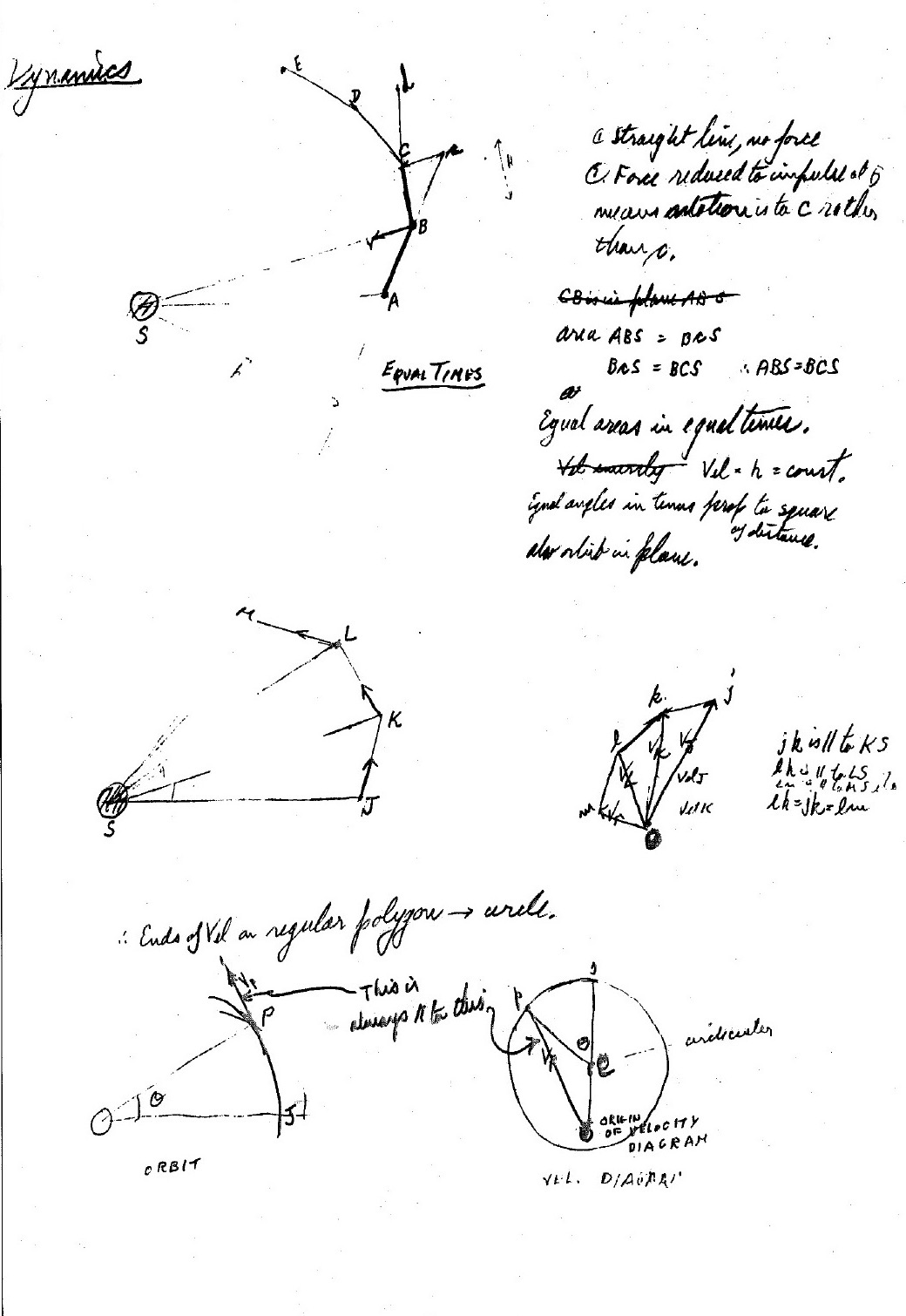
Feynman’s sparse handwritten page preserves the hinge of the argument: equal areas in equal times on the position diagram, Sun-directed changes of velocity chained in order, and the observation that the ends of those velocity steps approach a circle. The page is a compressed score for a performance, not a readable substitute for the blackboard sequence.
This full-content detail trims only the page’s empty outer margin. The words “equal areas in equal times” sit beside the paired orbit and velocity diagrams that the Goodsteins later had to unfold into a continuous proof.
1965 / OMITTED
It falls outside the canonical set.
Robert Leighton received Feynman’s notes and sketches, but apparently decided not to include the special lecture in the final 1965 volume of The Feynman Lectures on Physics, which dealt primarily with quantum mechanics. The surviving tape, partial transcript, and notes remained disconnected from a publishable visual sequence. In time, the lecture was forgotten.
1992 / FOUND
Judith Goodstein finds the unfinished lectures.
In April 1992, archivist Judith Goodstein was asked to sort Robert Leighton’s long-unused office. In a storage closet she found the unfinished Feynman lecture material among the editorial and publisher files: raw transcripts, Feynman’s notes, and a partial transcript dated March 13, 1964.
1993 / MATCHED
The fragments become one identifiable lecture.
While cataloging the original tapes in September 1993, Judith matched five unpublished recordings to five unfinished transcripts from Leighton’s files. Four had blackboard photographs. The planetary-motion lecture—the one that most depended on a changing geometric construction—did not.
That December, the Goodsteins took tapes, transcripts, photographs, and notes to Frascati and tried to revive the unpublished lectures. They abandoned the planetary-motion project because hearing Feynman’s voice was not enough to recover what his audience had watched him build.
1994 / RECONSTRUCTED
David Goodstein rebuilds the missing blackboard.
In December 1994, the Goodsteins tried again during an eleven-day voyage aboard the S.S. Rotterdam. This time David worked from the transcript, Feynman’s few pages of notes, selected pages from Kepler’s New Astronomy, and Newton’s Principia. The first break came when he matched Feynman’s opening sketch to Newton’s diagram.
By the ship’s arrival in Fort Lauderdale on December 21, he understood the full chain of reasoning. What was recovered was not a missing photograph but an executable relation between voice, notes, historical geometry, and the blackboard sequence they implied.
Read the exact Drive-supplied Goodstein and Goodstein excerpt · 1996 Caltech Engineering & Science, 59 (3), pages 14–21. Caltech’s archive record permits individual educational, research, and non-commercial reproduction; these source materials remain outside the instrument’s MIT software license.
NOW / TRANSLATED
Two spaces, one shared instant.
On the horizontal plane, Kepler’s area law marks equal times by equal swept areas. Over those matched intervals, the inverse-square pull supplies Sun-directed changes of velocity; chained on the vertical plane, they close into a circle. The orange planet and blue velocity point are one event represented twice; the dashed bridge is editorial correspondence, never a physical tether.
That is the proof move this instrument translates. Position space is the trace to be recovered; velocity space is the decisive change of language. Together, the 3D staging, camera views, bridge, and sound form another contemporary translation layer, not a feature of Feynman’s original presentation.
Position spaceOrbital plane
Velocity spaceOrthogonal plane
One event · two representations
CONTEMPORARY TRANSLATION · IFTHIS / 2026
The recovered argument, set back in motion.
The orange body and blue velocity point remain one synchronized event while their paths inhabit different geometric spaces. This live 3D coda is an interpretive rendering, not new historical evidence.